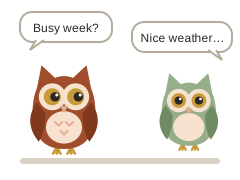
Someone asks "Busy weekend?" and your mind goes blank. Or you answer honestly and in detail, then realise they only wanted "Yeah, not bad, you?". Small talk can feel like a game everyone else learned the rules to, and nobody told you.
If that sounds familiar, you're not doing anything wrong. Here's why small talk can be so hard, and a few simple ways through it.
Why small talk can feel pointless or draining
Small talk is often less about the words and more about the ritual. "How are you?" usually isn't a real question. It's a way of saying "I see you, we're friendly". If you tend to take words at face value, or you prefer conversations with a clear purpose, that hidden meaning can be confusing.
There's also a lot to juggle: what to say, how much, and whether the other person is still interested, often in a noisy room.
So if small talk wears you out, it may be partly because you're working across a difference, and partly because you're masking while you do it. Both take energy.
You don't have to love it
You don't need to become a natural at small talk. The aim is just to have a few tools ready for when you can't avoid it, so it costs you a bit less.
And where you can opt out, you're allowed to. You could skip the coffee queue chat, eat lunch somewhere quiet, or arrive at an event just as it starts rather than early. Choosing less small talk isn't rude. It's managing your energy.
Simple ways through
Imagine it's the work Christmas do, and a colleague you barely know wanders over. Having two or three lines ready can take the pressure off.
The National Autistic Society also suggests that if someone stops asking questions back or keeps looking around the room, they may want to end the conversation (National Autistic Society). That's not necessarily about you.
Easy openers and exit lines
| Situation | Easy opener or exit line |
|---|---|
| Waiting for a meeting to start | "Have you had a busy morning?" |
| Work kitchen or coffee queue | "Anything good planned for the weekend?" |
| A party where you know the host | "How do you know [host's name]?" |
| A hobby group or class | "How long have you been doing this?" |
| Someone mentions a holiday or film | "Oh, what was that like?" |
| Neighbour in the corridor | "Hiya, all right? Have a good day." (A friendly line can be the whole conversation.) |
| You need to leave a chat | "It's been good to catch up. I'm going to grab a drink / find my seat." |
| You're running low on energy | "I'm going to get some fresh air. Nice talking to you." |
| Leaving an event early | "Thanks for having me. I'm going to head off while I've still got some energy." |
Change the words so they sound like you. Keeping a few in your phone's notes app is a perfectly good idea.
When it goes wrong
Say you overshare or misread a joke. Awkward moments happen to everyone. A simple "Sorry, I went off on one there!" can reset things, if you want to say anything at all.
If speaking itself feels hard at times, our article on what to do when speaking feels difficult may help.
Explaining it to others
If small talk is a struggle, you might decide to tell people who matter to you. "I'm not great at chit-chat, but I'm happy to talk about proper stuff" can help someone understand you're not being cold. There are more ideas in our guide to explaining your needs to friends and family.
If you're the non-autistic person in the chat, it helps to ask clear questions, accept short answers, and not take a lack of chit-chat personally.
References
- National Autistic Society. Making friends: a guide for autistic adults. autism.org.uk/advice-and-guidance/family-life-and-relationships/making-friends/autistic-adults
- Cook, J., Crane, L., Bourne, L., Hull, L., & Mandy, W. (2021). Camouflaging in an everyday social context: An interpersonal recall study. Autism, 25(5), 1444–1456. doi.org/10.1177/1362361321992641
- Crompton, C. J., Sharp, M., Axbey, H., Fletcher-Watson, S., Flynn, E. G., & Ropar, D. (2020). Neurotype-matching, but not being autistic, influences self and observer ratings of interpersonal rapport. Frontiers in Psychology, 11, 586171. doi.org/10.3389/fpsyg.2020.586171