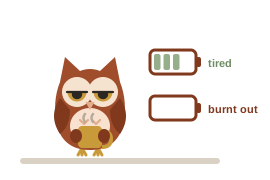
You've had a long few weeks and you're exhausted. Is this the kind of tired a good weekend will fix, or is it something deeper? When everything feels heavy, it can be hard to tell.
This article offers a rough way to tell ordinary tiredness and autistic burnout apart. It's a guide to help you reflect, not a test or a diagnosis.
Why the two get mixed up
From the inside, tiredness and burnout can feel similar at first. Both involve low energy, and both make everyday things harder.
The difference is often less about how tired you feel today, and more about how long it lasts, what rest does for it, and what else changes alongside it. If you'd like to know why burnout is so easy to miss in the early stages, we cover that in why autistic burnout can creep up unnoticed.
The main differences at a glance
| Ordinary tiredness | Autistic burnout | |
|---|---|---|
| How long it lasts | Usually days | Often months |
| What rest does | A good night's sleep or a quiet weekend usually helps | Rest helps a little, but you don't seem to "bounce back" |
| Everyday skills | Slower, but still there | Things you can usually do, like talking, cooking or organising, become much harder or stop |
| Sensory tolerance | Roughly as normal | Noise, light or touch become harder to cope with |
| Autistic traits | Much the same | May become more noticeable, or harder to hide |
| What it seems to come from | A busy day, poor sleep, a one-off event | A long build-up of stress, masking and demands that don't fit your needs |
Not everyone in burnout will recognise every row, and some rows can have other causes too. Use the table to spot patterns, not to label yourself.
A tale of two Mondays
Imagine it's Monday morning after a busy week that ended with a friend's birthday party. You're tired and a bit flat. But by Wednesday, after a couple of early nights, you're mostly back to yourself. That looks a lot like ordinary tiredness.
Now imagine a different Monday. You've been tired for weeks. The weekend didn't help. Answering a simple message feels like too much, the office lights feel painfully bright, and you've stopped cooking because deciding what to eat is overwhelming. That pattern, especially if it keeps going, is closer to what many autistic people describe as burnout.
How burnout differs from depression
This is where it gets genuinely tricky, so let's go gently.
Autistic burnout and depression can look alike. The NHS lists low energy, lost motivation, sleep problems, difficulty making decisions and little enjoyment of life among the signs of depression (NHS). Many of those overlap with burnout.
But they aren't the same thing. Both studies above describe autistic burnout as distinct from depression, and the second calls for more work to help clinicians tell them apart (Higgins et al., 2021). It's also possible to experience both at once.
You don't have to work this out on your own. A GP can talk through what's going on and help you understand what might help. The NHS advises seeing a GP if you have symptoms of depression for most of the day, every day, for more than 2 weeks (NHS).
Explaining it to others
People often say "everyone gets tired". They mean well, but it can feel dismissive. You might find it easier to point to the difference in recovery: "This isn't the kind of tired that a weekend fixes. I need less on my plate for a while, not just a lie-in."
The National Autistic Society notes that autistic burnout affects all areas of life, which is part of what sets it apart from work-related burnout (National Autistic Society). That can be a useful point to share with family or a manager.
References
- Raymaker, D. M., et al. (2020). "Having all of your internal resources exhausted beyond measure and being left with no clean-up crew": Defining autistic burnout. Autism in Adulthood, 2(2), 132–143. doi.org/10.1089/aut.2019.0079
- Higgins, J. M., et al. (2021). Defining autistic burnout through experts by lived experience: Grounded Delphi method investigating #AutisticBurnout. Autism, 25(8), 2356–2369. doi.org/10.1177/13623613211019858
- NHS. Symptoms: Depression in adults. nhs.uk
- National Autistic Society. Autistic fatigue: a guide for autistic adults. autism.org.uk